What a campaign cost
The cost block on a campaign report — what we charge you for sending, what WhatsApp charges you separately, and why the second number is our estimate rather than a bill.
Every campaign report carries a What this campaign cost block, below what the campaign produced and above the delivery breakdown. There are two numbers in it, they come from different places, and only one of them is ours.
What we charge you
Today, nothing. Campaign sending is not yet priced: there is no per-message charge set on any account, so the block leads with how many messages went out and then says, in as many words:
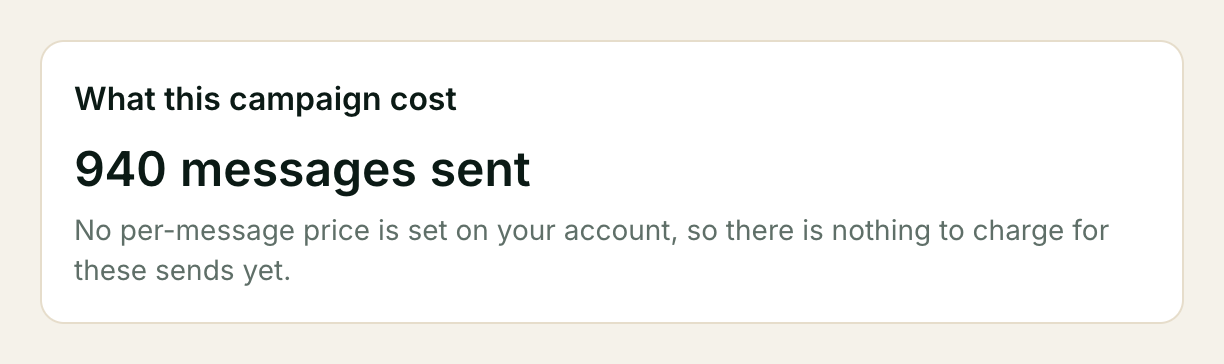
That is not a loading state and not a zero. You will not see “₹0” here, and that is deliberate — a zero would be a claim that campaigns are free, and nobody has made that claim. There is no published per-message rate to quote you either, in this page or anywhere else; when one is set, it will appear on your own account first.
Once a price does exist, the same block shows it and does the multiplication: the sends, the total, and beneath them the rate, with the note that messages that were skipped or never left are not charged.
We charge for messages that left, not for people on the list. A campaign that selected 1,000 people and sent to 940 is charged for 940. The 60 who were skipped — no consent on file, opted out, an unusable number — never became messages and never appear on an invoice. This is the same “sent” number the audience section of the report shows, deliberately: a bill that disagreed with the report would be a bill you could not check.
A message that was sent stays charged even if it was never delivered. Once it has left our side it has been sent, and WhatsApp charges us for it. The delivery figures further up the report can move afterwards; this number does not.
What WhatsApp charges you
WhatsApp bills you directly for campaign messages, on its own account, at its own rates. That is between you and Meta, and it does not come through us.
Where we can, the report shows our estimate of that amount:
Our estimate of what WhatsApp charged you for these messages: ₹75.20 (+91/marketing rate). This is our own working, not a bill and not a figure from WhatsApp.
Three things about that number, and they matter:
- It is arithmetic we did, from rates typed into our system — the number of messages you sent, multiplied by the rate on file for the country most of them went to. It is not something WhatsApp told us about your account.
- If it is missing, that is because no rate is on file for the country in question, and we would rather show nothing than show a figure we invented. A missing estimate is not a zero.
- Your WhatsApp invoice is the one that counts. If the two disagree, theirs is right. Use ours to sanity-check the order of magnitude and to compare one campaign against another — not to reconcile to the rupee.
We do not add anything to what WhatsApp charges you, and we never resell their messages. The estimate exists so that “was this campaign worth it?” is a question you can answer without opening two systems.
Putting it against what the campaign produced
The cost block sits below everything the campaign produced, on purpose. What a campaign cost is the least interesting thing about it next to what it did — the deals and the pipeline value at the top, the audience next, and the opt-outs directly above the cost. Only the delivery breakdown and the per-person target list come after it.
A campaign that cost a few hundred rupees and produced one deal has paid for itself many times over. A campaign that cost the same and produced eleven opt-outs has cost you something that does not appear in either number: the goodwill of eleven people, and a little of your number’s standing with WhatsApp. Read all three together — that is why they are on one page.
Related
Still stuck? We answer support mail the same working day.
Email support